
The Great Wall of Han Dynasty Tours
- The Great Wall of Han Dynasty Hiking Trip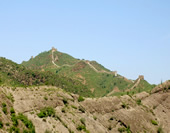 Han Dynasty was influencing the whole world at that time, taking trip to understand Han culture is a lot of foreigners'choice.Through the Han Great Wall history below, you might will get more intrests. In 206 B.C., the Qin Dynasty was overthrown due to its tyrannical rule mostly for the large expenses required for building the Wall. In 202 B.C., after several years' civil war, it was finally replaced by a new feudal dynasty -- the Han Dynasty. Accompanying the renewal of the economy during the post-war time, Huns in the north was stronger than ever and ambitious. On the other hand, the economy of the Han Dynasty recovered, and the military strength was becoming powerful too. To consolidate the frontier, keep Xiongnu outside, ensure a peaceful environment and protect the smooth trade with kingdoms in West Asia, Emperor Hanwudi ordered to build the wall, general Weiqing set up Shuofangzhen County and repaired a part of the wall left by the Qin Dynasty.
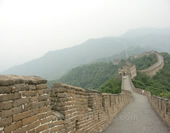 Later, Han built walls mainly for three times. And the three walls combined as one, celebrated as the Hexi-Region Wall of Han Dynasty, which linked up to a fair part of the Qin-Dynasty Wall, forming a new wall that ran up to 10,000 kilometers, the longest wall in Chinese history that traversed present six provinces, i.e. Liaoning, Inner Mongolia, Hebei, Ningxia, Gansu and Xinjiang. The east end of the Wall extended to as far as the north part of Korea. Containing a large part of the Wall of the Qin Dynasty, the 10,000-kilometer Wall is also referred to as the Qin-Han Great Wall. Any trip to China would be incomplete if the Great Wall hiking is not on the tour itinerary. The challenging Great Wall hiking tours will give you a vivid knowledge of its history, functions and awesome size.Feel free to contact us if want to know more Great Wall trips.
Your Question & Quick Answer*Design Your Own Trip
Great Wall Trips
Booking Procedures
- 1Select Tour Products

- 2Inquiry or Tailor-made
- 3Consulation & Alteration
- 4Deposit & Full Payment
- 5Final Confirmation
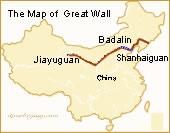
Great Wall Maps







Booking Procedures | Terms & Conditions | Payment Methods | Links | Site Map | About Us | Contact Us | Travel Agent
Copyright 2008, All rights reserved.. itourbeijing.com professional Beijing tour operator and China travel service
TEL: 86-10-85968802 (Universal) 1-888-288-9328 (North America) E-mail: contact@itourbeijng.com
Tours Index | China Tours | Beijing Tours | Xi'an Tours | Shanghai Tours | Guilin Tours | Tibet Tours
China Travel | Beijing Travel | Shanghai Travel | Xi'an Travel | Guilin Travel |The Great Wall Tours
China Golf | Beijing Golf | Shanghai Golf | Xiamen Golf | Beijing Map | Beijing Side Trip | Yangtze Cruise | Travel Picture